The Peanut Butter Case Study pt. 2

“You can’t buy back your respect; you can’t buy back your career. You only get one, so I don’t want to mess that up.”

Shia LaBeouf

I only get one chance to make this movie, and I do not want to mess up. So I am continuing research on The Peanut Butter Falcon that will help me to establish how it should be produced and distributed.

Production

The production cost for this movie was 6.2 million dollars. While this sounds like a lot of money, this is actually considered a low budget film. For example another drama comedy movie, Good Morning Vietnam cost 13 million dollars to make.

This 6.2 million dollars included a $20,000 proof-of-concept video (I will explain more about what a proof-of-concept video in a later post ) and because of this video many famous actors, like Shia LaBouf, Dakota Johnson, and John Hawkes gained interest in being in the film. Soon enough production began in Georgia in July 2017.

Production cost was kept low through the unique creative work of the actors and directors. Many viewers and critics praise the writers/directors use of rafting through the North Carolina marshes as a vehicle for the story, saying it was a great “modern retelling of the Huckleberry Fin adventure.” But when writer/director Tyler Nelson is asked what gave him the inspiration for this “vehicle” he simply states,

“I knew we could go shoot in the marshes. I knew that we could build a raft out of trash because we had a friend with a junkyard. We couldn’t do a space film, you know? It’s just, what do you have?”

Tyler Nelson

In addition to props, the cost of hiring actors was also reduced by allowing members of the town in which they were shooting to play a part in the movie. While a majority of the roles they played were extras some got to play major roles. For example, Rob, a local fisherman, acted as the man who fired the main character Tyler (Shia LaBeouf) from his fishing job.

“Shia got a job on a fishing boat during pre-production to be authentically a crab fisherman, and that guy Rob ran the boat and taught him how to fish,”

“So when it was time to run that scene, we were like, yeah, he’d be good in there, and even better than an actor.”

“We just pulled him over and were like, ‘Hey, come over here and do this scene!’ And he was like, ‘OK!’ I don’t even think he has a TV.”

Michael Schwartz and Tyler Nelson

The inclusion of these local “actors” not only made the production of the movie cheaper, but made the movie seem more authentic. It felt real to the actors, and this energy was transferred to the viewers, making a stronger connection between the audience and the film.

In my next post I will be continuing this case study with an evaluation of how The Peanut Butter Falcon was distributed.

Resources:

“Bluegrass, Low Budgets, and Professional Wrestling: How the Indie Sensation ‘The Peanut Butter Falcon’ Was Made.” /Film, 7 Aug. 2019, http://www.slashfilm.com/making-of-the-peanut-butter-falcon/.Ramos, Dino-Ray.

“’The Peanut Butter Falcon’s Shia LaBeouf, Zack Gottsagen And Filmmakers Talk Non-Cutesy Authenticity Of SXSW Film.” Deadline, 27 Aug. 2019, deadline.com/2019/03/peanut-butter-falcon-shia-labeouf-zack-gottsagen-tyler-nilson-michaek-schwartz-sxsw-1202576191/.
The Peanut Butter Case Study

The Peanut Butter Falcon star Zack Gottsagen made history as the first Oscars presenter with Down Syndrome.”

MSN Entertainment

Now that I have researched scripts and determined how to write my own, I now need to research how our movie should be produced and distributed. In order to do this, I decided to look at a low budget comedy drama film that did the same.

The low budget drama comedy I chose was The Peanut Butter Falcon released just last year, directed and written by Tyler Nilson and Michael Schwartz.

History

The star of The Peanut Butter Falcon Zack Gottsagen met Tyler Nilson and Michael Schwartz at a camp that brought together artists with and without disabilities. Zack Gottsagen has Down Syndrome and when Tyler and Michael were discussing the challenges he would face as an actor Zack challenged them to write a role that only he could play, and so they did.

This is how The Peanut Butter Falcon, the story of a young man with Down Syndrome with aspirations of being a professional wrestler came to find a family in a fisherman and a local caretaker, both with troubled pasts.

Much of the story was based on Zack’s own life, but instead of struggling to be a wrestler, Zack struggled to be a famous actor.

Audience

The decision to make wrestling a key theme within the movie was not done without thought.

For years there has been a connection developing between the fans of wrestling and the fans of Hollywood. Both enjoy the detail and precision put into the performance of stunts. Both love the costuming and design that goes in to creating unique characters. Not to mention the fact that many famous wrestlers have made a career as movie actors as well. This includes Bill Goldberg, Kevin Nash, Steve Austin, John Cena, Dave Bautista, Andre the Giant, Hulk Hogan, and Dwayne Johnson just to name a few.

Because of this movie’s inclusion of famous WWE stars-turned-actors like Jake “The Snake” Roberts the film drew not only the attention of normal Hollywood fans, but professional wrestling fans as well.

This plot choice created a larger audience for the small budget independent film, enabling its success.

With the help of the production and distribution of this movie Zack’s dream to become a famous actor has become a reality. Just this past weekend at the 2020 Oscars Zack Gottsagen became the first presenter with Down Syndrome.

In my next post I will continue this case study of The Peanut Butter Falcon and how it was produced and distributed as I use it to determine the best way our movie could be produced and distributed.

Resources:

McKnight. “The 10 Greatest Wrestlers Turned Actors.” CINEMABLEND, CINEMABLEND, 8 Oct. 2018, www.cinemablend.com/new/10-Greatest-Wrestlers-Turned-Actors-71664.html.

‘Peanut Butter Falcon’ Star Zack Gottsagen Becomes First Actor With Down Syndrome to Present at Oscars, www.msn.com/en-us/movies/oscars/peanut-butter-falcon-star-zack-gottsagen-becomes-first-actor-with-down-syndrome-to-present-at-oscars/ar-BBZOWHY.

“Bluegrass, Low Budgets, and Professional Wrestling: How the Indie Sensation The Peanut Butter Falcon Was Made.” /Film, 7 Aug. 2019, www.slashfilm.com/making-of-the-peanut-butter-falcon/.

Script Draft 1

“You can’t make a good movie with a bad script, no matter who’s involved.”

Dave Franco

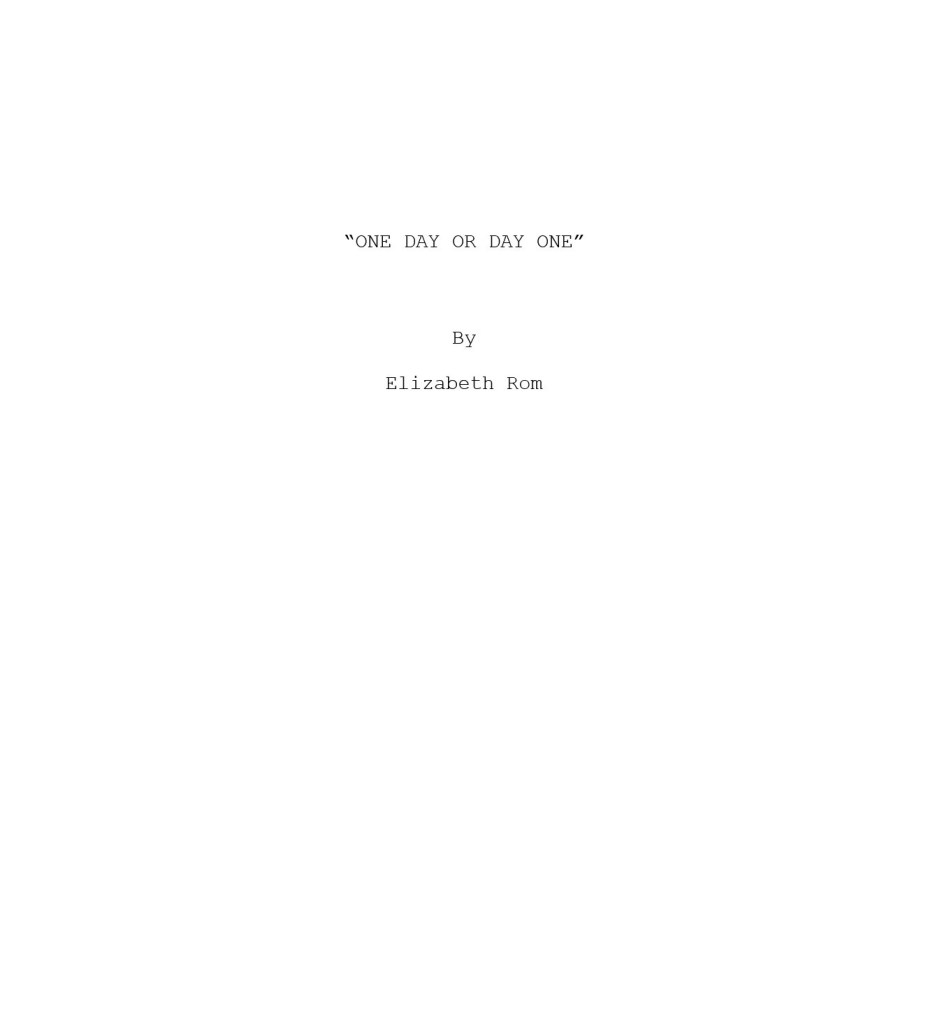
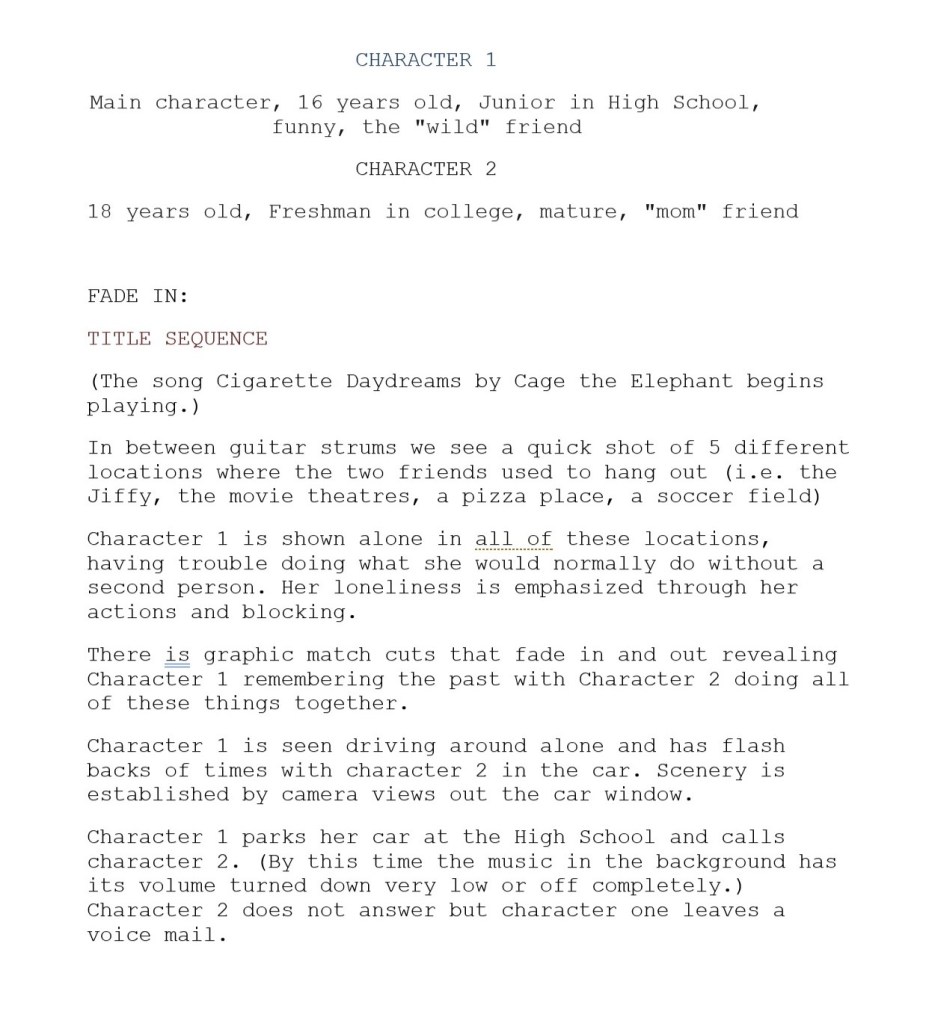
Here’s to hoping I do not have to do the impossible and make a good movie with a bad script. I have a long way to come when it comes to script writing but I thought I would share the first draft of the script for our opening sequence. Please enjoy knowing it still has to undergo some major edits and revisions.

No Day’s Off Script Writing (pt.2)

I think relationships are really hard. Each one gives you lessons that you need.

Jennifer Grey

While it can be hard to analyze scripts and learn to write one I’m hoping doing so will give me lessons that I need to write my script correctly. So in this post I will be continuing my analysis of script writing on how the writer of  Ferris Bueller’s Day Off describes characters and helps with movie production.

In addition to the writer’s description of sound talked about in my last post, the author also noted the presentation of different characters within each scene. What I found interesting about this was that the author not only described what the character looked like but key points about their character and the impressions the viewer was supposed to get of them.

 Much of this writing was done in a very informal tone and growing up being taught to write professionally I was thrown by how blunt the writing was. This is mostly seen in the author’s description of Jeanie.

“His older sister, JEANIE, walks into the room. She’s dressed for school. She’s cute and stuck-up. A major pill.”

Another surprise I was met with was that there was more in the script than there was in the movie. In the beginning of the script, the reader is met with a list of characters that would be in the following scene. This list included Kimberly and Tom, younger siblings of Ferris and Jeanie. Kimberly and Tom are not in the movie Ferris Bueller’s Day Off, which leads me to the conclusion that scripts are not the end all be all of what happens in the movie.

Scripts go under several steps of writing, reading, and rewriting.  New ideas are included as quickly as they are discarded until the director settles on what they think is best.

Maybe a four-child household would not have been as relatable to audience members. Maybe it made the scene too busy and distracted from the movie’s brand.

Either way these characters being nonexistent in the final film has shown me that it is okay if I don’t get my script perfect the first time around and that the first step is to try and write one.

Resources:

Click to access FerrisBuellersDayOff.pdf

No Day’s off for Script Writing

I’m not saying I’m a writer, but I’ve been in movies for a long time, and I think I could write a script for a movie.

Benicio Del Toro

Unlike Benicio, I have not been in movies a long time, but I do think I would be able to write a script for one. And if I could not write a script for a whole movie, at least I can write the script for the first two minutes of one. But in order to do this I need to first learn how to write a script.

When it came to learning how to write a script I turned to my go to movie. Which is, if you haven’t figured it out by now, Ferris Bueller’s Day Off, directed by John Hughes and released in 1986. When I found the script to this movie I was surprised and delighted to see my favorite movie described to me in almost the same way I had watched it. I included a link to the script below.

Click to access FerrisBuellersDayOff.pdf

One of the first things I noticed about movie scripts was that at the beginning of each scene there was a description of the setting in which the dialogue and action of the scene would take place.

Within this description the author would note what the senses of the viewer would be experiencing when watching the movie. The description noted key sounds that the audience would hear including music and background noise. Within Ferris Bueller’s Day Off this was done by the author presenting a long list of sounds the audience would be hearing.

“ A HOUSEHOLD IN THE MORNING. KIDS GETTING READY FOR SCHOOL. CLOCK RADIOS.KITCHEN APPLIANCES. SHOWERS. FIGHTING. PEOPLE YELLING. DOG BARKING. APPLIANCES BUZZING. CAR HORNS.”

This method of description was not something I was used to seeing or writing before, but I was excited to learn more about. In my next post I’ll be analyzing more of the Ferris Bueller’s Day Off script and how I can use it to start writing my own.

Audience

I think you should make a movie that has an audience.

Mathew Vaughn

Thank you Mathew Vaughn, I think I will make a movie that has an audience. Drama comedies attract a variety of audience’s depending on the themes presented in the movie, the actors in the movie, and how it is advertised.

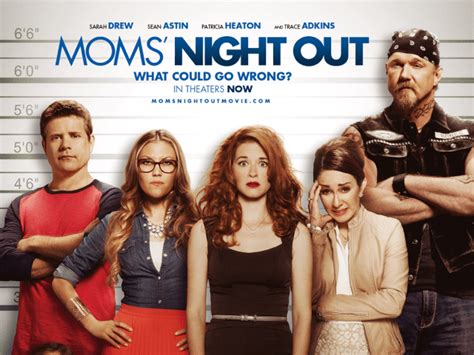
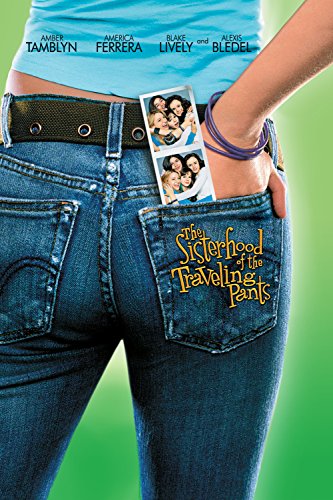
A drama comedy that addresses themes like divorce, a dysfunctional family, or child care and includes famous female actors like Tina Fey, Blake Lively, Rebel Wilson, or Anna Kendrick will attract a middle age female audience who are likely mothers.

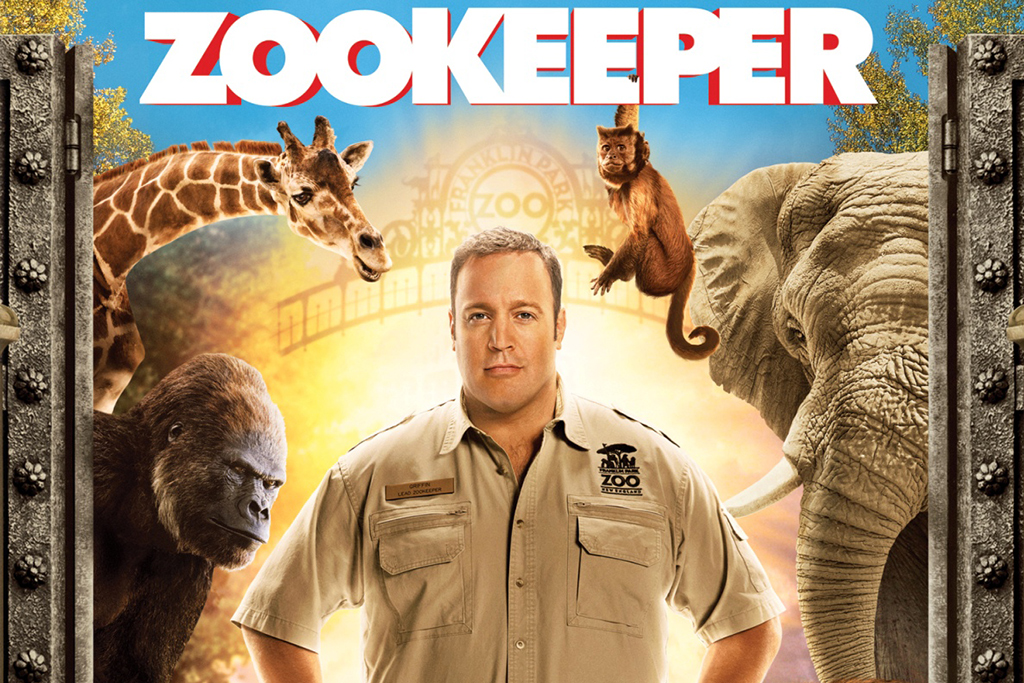
A drama comedy that addresses themes like a midlife crises, difficult work life, or fatherhood and includes famous actors like Adam Sandler, Kevin Hart, Paul Blart, or Kevin James will attract middle age male audiences who are likely fathers.

The drama comedy we are trying to make will include teen actors and will likely center on themes of coming of age, newfound independence, or school life. Because of this it will likely attract a teen audience, specifically a female teen audience.

Male teen audiences are primarily attracted by action, comedies, and comedy action movies. They do not explore other genres often unless attending a movie with a group or on a date with other teen audience members with varying genre preferences.

The movie going habits of the teen audience are mostly predictable. Teens attend school Monday through Friday so teens will go to movie theaters more frequently Friday night and over the weekend. Teens are also more likely to attend movies at night rather than earlier in the day.

Given this information we can start to plan when a movie should be released into theaters. Releasing the movie Friday night would increase opening day sales. When targeting teen audiences these sales can also be further increased by releasing the movie at the beginning of a school break. So if the movie is released at the beginning of spring or summer break more teens will be available and want to make plans with their friends to go see the movie.

Resources:

“Matthew Vaughn Quotes.” BrainyQuote, Xplore, http://www.brainyquote.com/quotes/matthew_vaughn_248752.

It’s Kind of More Research (pt.2)

I’m the sort of actor who doesn’t really prep a lot – I don’t do a lot of research for parts. I just go for it, and I usually pull through.

Keir Gilchrist

Unlike Keir, I am going to do a lot of research on my genre’s opening sequences. That being said here is my continuation of my analysis from It’s Kind of a Funny Story.

Costume

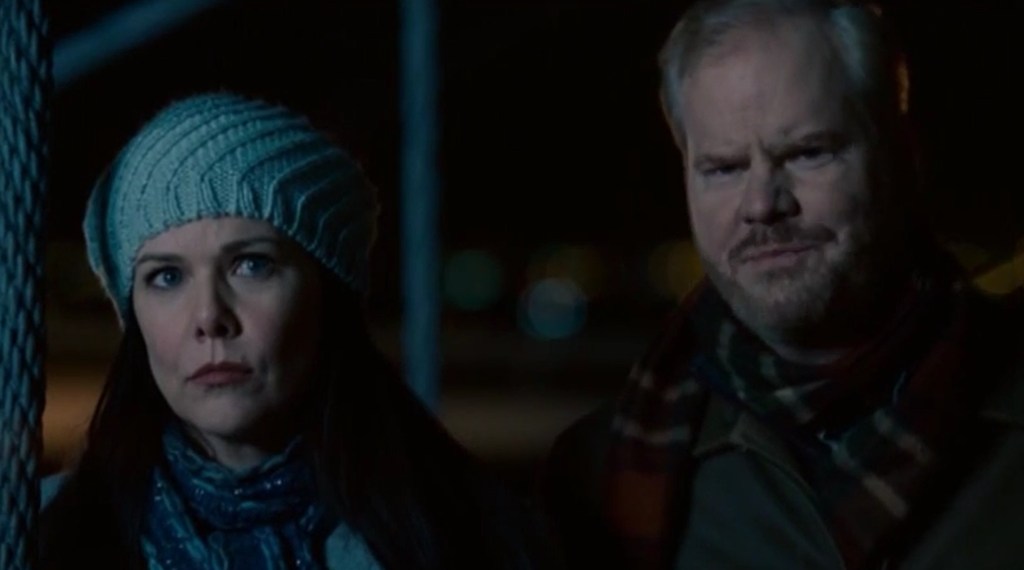
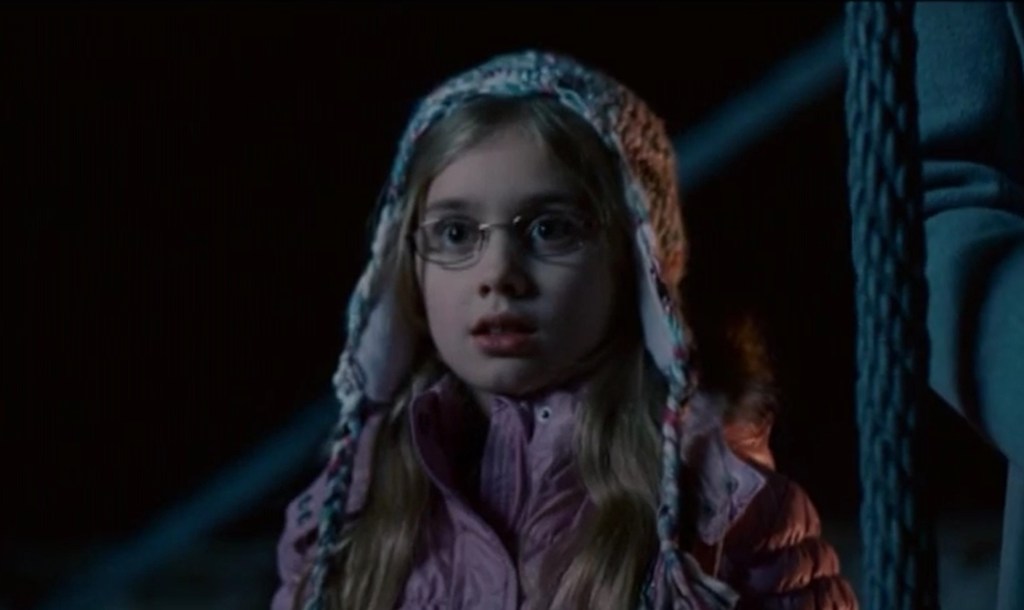
I had just left off discussing how the director’s use of sting made way for the dramatic change in tone presented by the introduction of three new characters. These three new characters are Craig’s parents and younger sister. They are presented as a normal nuclear style family ( a mom, a dad, a son, and a daughter) and every detail, from their clothing to their dialogue, emphasize this fact.

Their costumes present them as a kind loving family. Both women are wearing bright colorful hats and scarves, the mother is wearing natural looking makeup and the daughter has her hair done in pigtail braids. This shows the mother’s caring nature by showing she would not only take time to take care of herself (makeup) but her child as well (braided hair and hat). In addition to this the girl’s hair style also emphasizes her innocence. The father’s style also portrays him as a kind bumbling father, a common stereotype in family films. He is not super fit or out of shape, and he has a receding hair line but has a beard.

Dialogue

Dialogue also plays a key role in portraying this family dynamic. The father refers to Craig as “Sport” and the mother refers to him as “Honey” both common endearing terms used by parents that seem cheesy and out of place in the given context.

The family’s kind hearted, innocent nature seems almost sarcastic given the situation. It is odd that the parents are not freaking out that their son is trying to kill himself, they act as if it has happened before, maybe it has. This weird aspect of the story adds the comedy to the drama.

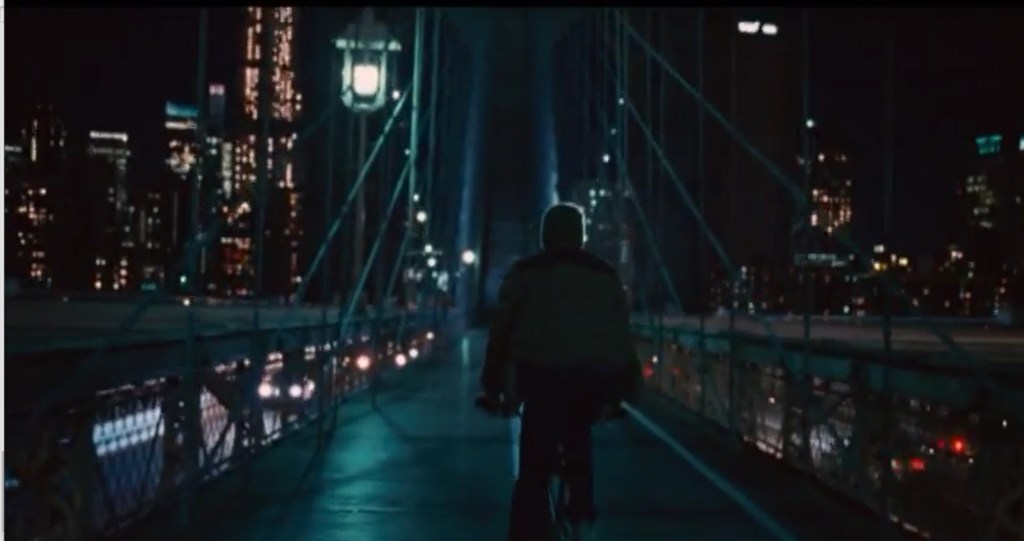
Other aspects of dialogue outside of what the parents call Craig also add to this comedy. Throughout the enter interaction they have with Craig they are more concerned about the state of Craig’s bike than Craig himself.

Throughout the dialogue with the bike it seems like they are using the bike as a symbol for Craig. The fact that the father has spent a lot of money on the bike and that the sister may want to use it when she is older symbolizes that the parents have put a lot into raising Craig and want him to be around to help raise his sister too.

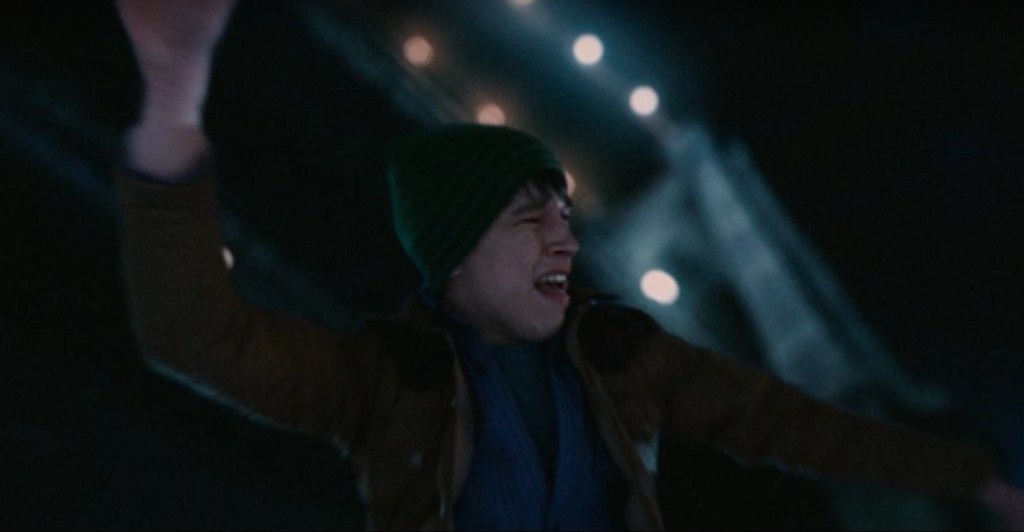
This blatant disregard for emotion that comes with comedy mixes with the harsh realities presented by the dramatic plot of this excerpt from the movie making it off putting at times to the viewer. But over all the effect is intriguing and when mixed with awesome freeze frames like the one below,

the viewer begins to see what puts the funny in It’s Kind of a Funny Story.

Resources:

“Keir Gilchrist Quotes.” BrainyQuote, Xplore, http://www.brainyquote.com/authors/keir-gilchrist-quotes.

YouTube, youtu.be/s6g71gTLZQE.

It’s Kind of More Research (pt. 1)

I have a lot of growing up to do. I realized that the other day inside my fort.

Zach Galifinakis

Just like Zach Galifinakis, I have a lot of growing up to do, especially when it comes to learning how to make a great title sequence. That is why in this post I will be analyzing the opening title sequence to It’s Kind of a Funny Story, directed by Anna Boden and Ryan Fleck.

It’s Kind of a Funny Story was released in 2010, but it is not a movie I have seen before so it will be interesting to see what I am able to gather from just the first two minutes and twenty three seconds of the film.

I chose to analyze this film because unlike The Devil Wears Prada this film centers around a teen actor. The film we are trying to create will also center around a teen actor so I thought analyzing this film would be helpful. Again, for the sake of time, I will only be noting the most key elements of the title sequence.

Sound

Before images from the movie even begin to show on the screen the sounds present in the film’s world is already playing in the background of beginning credits. This helps to draw the viewer in and makes them feel like they are in the movie itself.

As you can tell this sound did not include any dialogue, however it included both diegetic sound and music at a low volume. The music that was being played also matched the tone of the scene perfectly. The slow somber notes that were held out by the instruments revealed the main character’s depressed emotions to the audience.

Then a voiceover begins as the image of the main character comes on the screen. Unlike other forms of voiceover this is not revealing to the audience what the character is thinking inside his head but informs us that the voice we are hearing is this same character, but in the future. The voice of the character is narrating us through his past.

Right as this is established and the climax of the scene begins to build the music in the background stops and we are met with what is called a sting. This sting, or loud surprising sound, is the combination of Craig’s younger sister yelling his name and a large semi truck speeding by and honking its horn. This sound is jarring and immediately relieves the building stress of the viewer who is worried that no one will be there to stop Craig from what he is about to do. This loud sound also signifies a change of tone that I will explain more in my next post.

Resources:

“Zach Galifianakis Quote.” A, http://www.azquotes.com/quote/609714.

What I’ve Learned

It’s always a pleasure to find something that matters.

Don Cornelius

Through my research so far I have found a lot of information that I believe will help me in the creation of my title sequence in the months to come. I want to take this post to make a list of the important details I think I will need to remember when it comes to planning and shooting our film.

What I learned from The Devil Wears Prada

  • Know what you’re trying to convey. (In The Devil Wears Prada it was contrast between the main character and the rest of the cast.)
  • It is never too early to establish themes and conflicts. (In The Devil Wears Prada themes like society’s view of women and body image were already being established.)
  • A little says a lot. Even small camera tilts can express emotions like anxiety or confidence.
  • You can use music! Just make sure its not over powering, diegetic sound and dialogue should still be present and audible.
  • Don’t just focus on the actors! Establish a setting with artistic backgrounds and thematic props.

Dramatic Comedy is a broad genre that allows a lot of room for the creative process to work its own magic, which is why I love it. When it comes to genre conventions there is really is no strict guidelines to follow, however, general themes and concepts should be included to create the desired dramedy feel.

What I learned about Genre Conventions

  • Make sure characters and the situations they are in are realistic. The audience has to relate to the film to get caught up in the drama.
  • End on a happy note, or some kind of “new start”
  • Take time to test wise cracks or the use of sarcasm in the script to make sure the jokes land with the audience.
  • Adding narration or breaking the fourth wall can be used in drama but I do not plan to use this in the film in the hopes of making it seem more realistic.
  • The use of music and surprise are present in both genres and I do plan to use these in the film.

What I learned about Film Settings

  • Drama Comedies are broad so your movie can be set ANYWHERE (as long as its relatable to the audience of course)
  • Most dramedy films occur in bright settings, the films are supposed to be light hearted. Most scenes will be shot during the day with more serious scenes shot at night or somewhere dark.
  • Movement is good! A lot of dramedies involve trips (especially road trips), they allow for a physical journey to symbolically match the emotional one taken by characters.
  • Choose settings wisely, they will impact costumes, props, and even key character aspects.

I will continue to add to these lists as I am researching in the hopes that looking back on them will remind me of important details to include in our final product. In future posts I plan to be looking at more opening scenes from the drama comedy genre as well as researching the audience we plan to reach with our film.

Resources:

“Don Cornelius Quotes.” BrainyQuote, Xplore, http://www.brainyquote.com/quotes/don_cornelius_401183.

Prada Quality Research (pt. 2)

The more you are in this business, the more humbled by it you become.

Meryl Streep

In continuing my research on The Devil Wears Prada I am becoming more and more humbled by it’s ability to say so much in so little time.

Editing

This entire title sequence is edited to be a montage, or a condensed series of events. Through this montage the director is able to present these four women getting dressed for the day without taking up important movie time. This use of montage also enables the director to establish the characteristics of several different characters within the film, rather than just one.

Another use of editing that seems to be the most noticeable is the use of match cuts. This allows for a smooth immediate transition that enables the creation of the montage.

Graphic match cuts seem to be the primary match cut used within the sequence. 

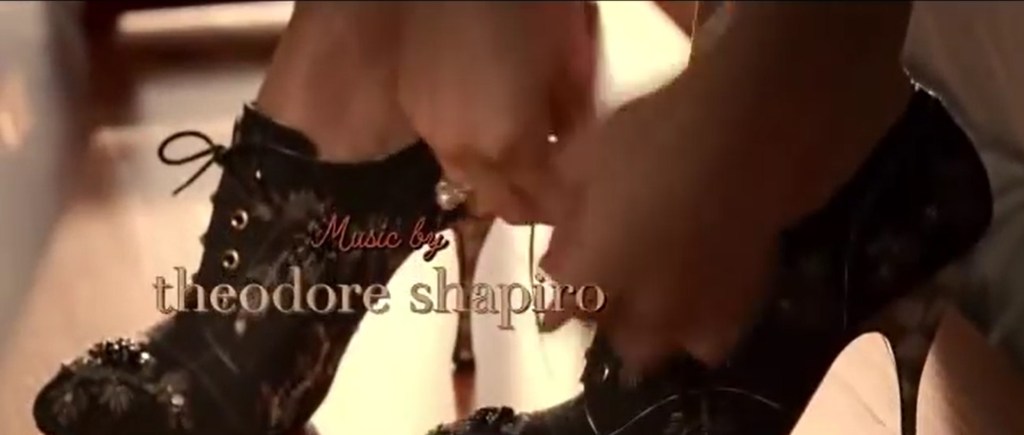
The image cuts between the four woman putting on their shoes. This is a graphic match cut because all of the shots include heels and their feet are the only thing within the frame, so all of the shapes within the shot match one another.

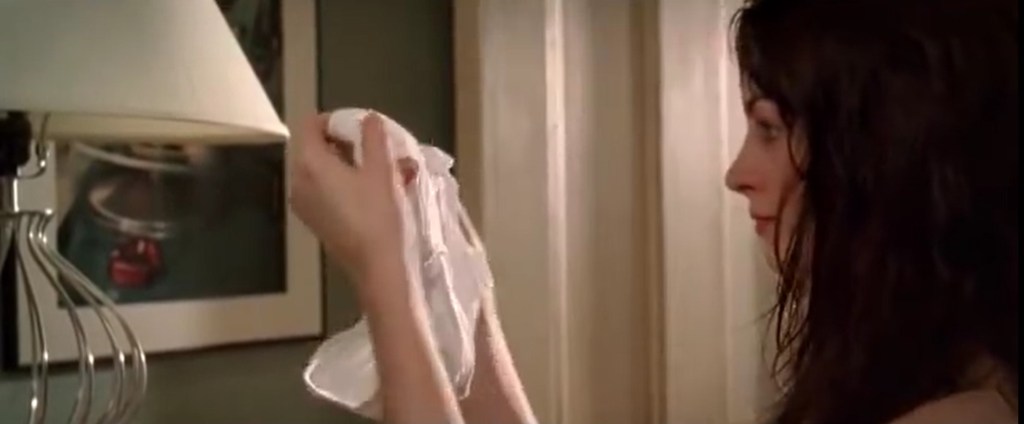
This is used throughout the clip as the image switches from different women as they get ready. We get a graphic match cut of the women putting on eye makeup, underwear, and jewelry. In these match cut the director emphasizes the difference between the main character and the three other women. While the three other women are putting a lot of effort into their outfits to make them look nice the main character is portrayed as being more haphazard in the way she gets dressed.

This is done by what I have called the modified graphic match cut. Where it is implied that there was supposed to be a graphic match cut but the director is trying to emphasize the contrast between two scenes or characters. I also call it a action match cut (NOT A MATCH ON ACTION CUT) where two characters are shown performing the same action but in different ways.

Camera Shots

The director uses establishing shots several times to orient the viewer. Because this is a montage that is showing characters getting from point A to point B (the women to work) it is important that the film shows where each event is taking place.

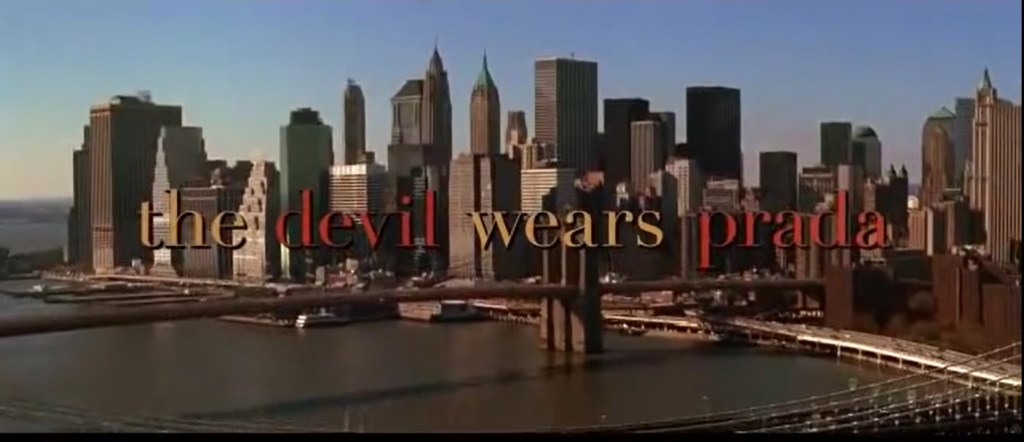
One of the first shots is an establishing shot depicting the New York skyline, where the entire movie will take place.

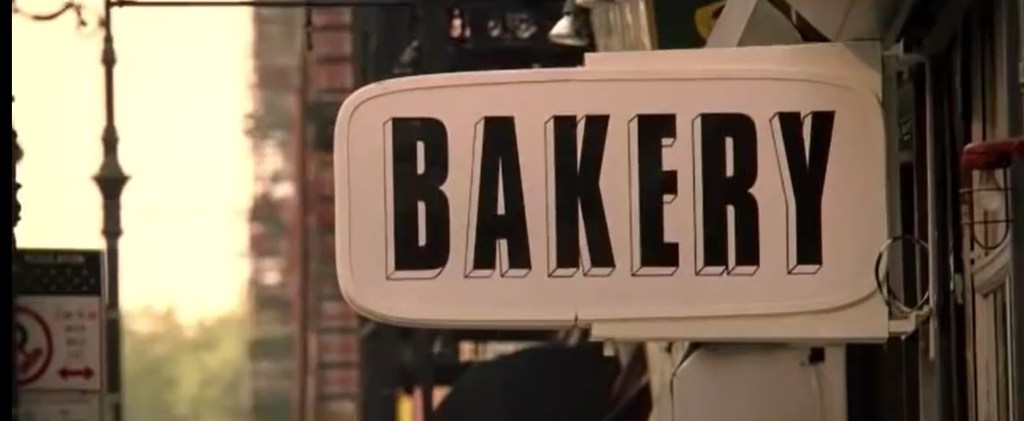
Another establishing shot is used later in the clip to show where the main character stopped to get breakfast. The emphasis of the bakery sign also plays a role in establishing the contrast between the main character and the rest of the women I discussed earlier in the post. She eats out, at a bakery, while the other women eat breakfast at home. Many of the other women are also shown eating very small amounts depicting them as health and weight cautious.

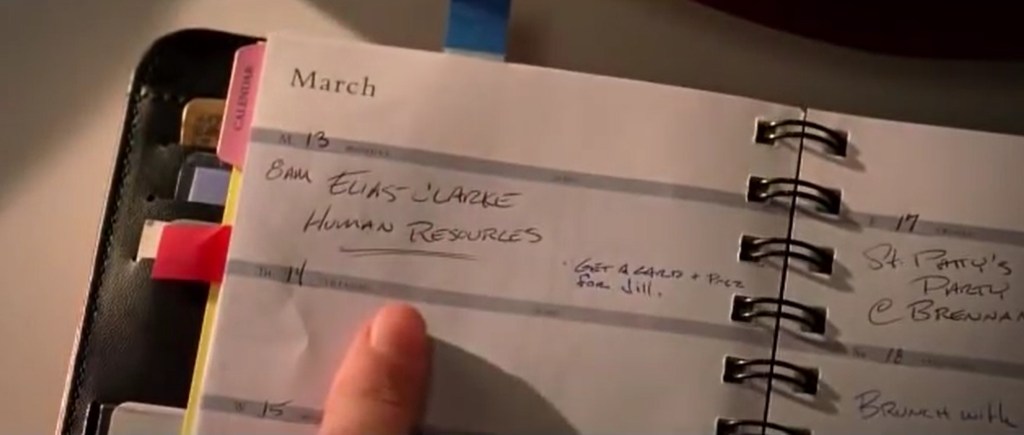
Close up shots are also heavily present in the title sequence creating a more intimate relationship between the viewers and the characters within the film. In addition to this, the director seems to be giving viewers a taste of what is to come and wants to show a distinct difference between the title sequence and the movie to follow. Close ups like the one shown above cane also allow viewers more context, the close up on the calendar inform us it’s March.

Camera Movement and Angles

Camera movement also plays a major role in this scene, especially once the women have left their apartments and are walking around New York.

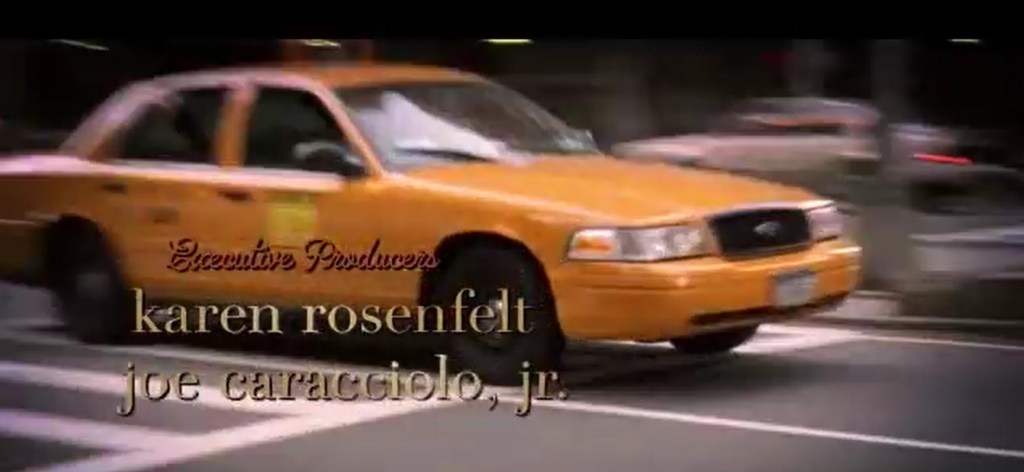
The camera pans back and forth tracking cars and taxis driving by. The camera also tilts on several occasions moving from the women’s high heel shoes up to their faces. This movement allows the viewer to make a connection between the shoes that they saw being put on earlier and the women putting them on. This helps to establish the different characters present within the movie. This camera tilt from foot to head is not used on the main character, instead the camera tilts from her making a face of anxious amazement, to the high rise building she is gazing at above her. This small movement, again illustrates the contrast between the main character and the other women in the film.

Design a site like this with WordPress.com
Get started